top of page

My Blogs

  • Writer: Mansee Mohta
    Mansee Mohta
  • Oct 7
  • 5 min read
ree

Major tech companies are explicitly designing AI products to drive ad revenue. For example, Meta just announced that all data from its AI chatbot interactions will feed its ad-targeting engine[1]. That means if a user chats about hiking gear with Meta AI, Meta can serve hiking-gear ads on Facebook/Instagram from that data[1][2]. Similarly, Google whose ad business generated $66.9 billion in Q1 2025 alone[3] is integrating ads into its new AI search interfaces. Google’s blog explains that ads will appear “where relevant” in AI-generated Overviews and its new “AI Mode” answers[4]. In one demo, Google’s AI search suggests a website-builder ad when a user asks about building a small business site[4]. These moves turn AI features into additional ad inventory. In short, companies like Meta and Google are building AI models not just as user features, but as channels for targeted advertising (a key revenue driver)[1][3].

  • AI Chat Data → Targeted Ads: Meta’s policy update highlights that rich AI chat logs provide “powerful signals” for ad targeting[2]. Likewise, Google notes that AI Overviews drive more search queries (including commercial queries), creating extra opportunities for advertisers[5].

  • Ads in AI Interfaces: Google is testing Search/Shopping ads in its AI Overviews and AI Mode (e.g. “Performance Max” ads can now appear in AI search answers)[4][3]. Other AI platforms (Perplexity, Microsoft Copilot, etc.) are exploring ad inserts too[6].

  • Ad Revenues Remain Core: Because ads are already Google’s (and Meta’s) primary cash cow, it was “inevitable” they’d extend ads into AI search[3]. Google’s Q1 2025 ad haul alone shows why: its core business depends on showing more ads to more engaged users[3]. By embedding ads into AI chat, companies expect to boost click-through and ROI for advertisers, which in turn grows their own revenues.


Revenue Impact of AI-Based Ads

AI-driven ads create new revenue streams and enhance existing ones. By capturing deeper user intent, platforms can charge more for precision. Meta expects that AI conversation data will refine user profiles and “improve [its] valuable ad products”[2]. Google likewise reports that users who see AI answers tend to search more – a 10%+ increase in query volume in some markets[5] – meaning more chances to serve ads. In practice: Google is expanding ad support (Search/Shopping ads) in AI Overviews and AI Mode, and qualifying existing campaigns (Performance Max, Shopping) to appear in those AI answers[4][3]. This translates directly into more ad clicks and revenue.

Moreover, some AI companies view ads as a way to monetize free products. OpenAI has acknowledged that it may one day adopt an ad-supported model to supplement its subscription income[7]. (Google and Amazon similarly favor their own services in shopping/search, so AI shopping features may mirror that play.) In sum, integrating AI and ads deepens user engagement and ad targeting, thereby strengthening the revenue stream. Companies are effectively turning AI usage into ad impressions or commerce fees, bolstering their bottom line.


Conversational Commerce and Fees

Beyond traditional ads, AI is spawning agentic commerce (in-chat purchasing) as a revenue source. For instance, OpenAI recently launched “Instant Checkout” in ChatGPT: U.S. users can now buy Etsy (and soon Shopify) products directly in-chat[8][9]. Unlike a paid product, ChatGPT’s commerce feature is free for users; instead, merchants pay a small fee per completed sale[10][11]. In practice, ChatGPT surfaces organic product results and when a user taps “Buy,” it handles the payment via Apple/Google Pay or credit card without leaving the chat[12][9]. This model gives OpenAI (and similar AI platforms) a cut of e-commerce transactions – effectively a new revenue slice beyond advertising. As one write-up notes, this in-chat shopping could shift power away from traditional gatekeepers (Google/Amazon) to AI agents, who may take fees or commissions[10][9]. Microsoft’s Copilot and search AI like Perplexity are launching analogous shopping integrations, suggesting a trend: AI agents as commerce brokers with monetization via transaction fees.


ChatGPT’s new shopping interface (“Buy It in ChatGPT”) lets users purchase items without leaving the conversation[12].

Platform Examples: Zomato, Swiggy, etc.

Many modern “platform” businesses rely heavily on selling ads or visibility rather than just their core service. A prime example is Indian food platforms like Zomato and Swiggy. Zomato’s own analysis shows that food delivery (with thin margins) is only a small fraction of its revenue[13]. Instead, “Zomato’s primary source of revenue is advertising.” Restaurants pay for top-of-list or banner placements to reach customers[14]. In other words, Zomato has built a high-frequency marketplace and monetizes not just delivery fees, but the data and exposure it offers partner restaurants. Similarly, Swiggy earns from restaurant commissions, delivery fees, and an expanding in-app advertising business. Restaurants on Swiggy can buy priority listings to boost visibility, and Swiggy explicitly cites in-app ads as a revenue source[15][16]. Both cases illustrate that ad-driven revenue can outpace the core product revenue. In fact, Zomato’s and Swiggy’s growth strategies emphasize that connecting advertisers (restaurants, brands) to the platform’s users is more lucrative than the delivery service itself[14][16].


Zomato and Swiggy illustrate multi-sided platforms. Both charge restaurants for advertising/promoted listings (in addition to delivery commissions)[14][16].


Key Takeaways: Leading tech firms are indeed creating AI models with monetization in mind. AI chat and search are being directly leveraged to insert ads and generate commerce fees, which enriches companies’ revenue streams[1][10]. Many modern businesses (from Google to food-delivery apps) follow a pattern: offer a free or low-margin service and earn primarily through advertising or platform fees. The Zomato/Swiggy example shows that even outside of big tech, companies design business models where data and ads can become the biggest moneymakers[14][16].

Sources: Recent TechCrunch and official reports highlight these trends (Meta’s AI ad plan[1]; Google’s AI search ads[4][3]; OpenAI’s shopping integration[10][11]) as well as analyses of Zomato/Swiggy business models[14][16]. All cited facts are drawn from these industry sources.


[1] [2] Meta plans to sell targeted ads based on data in your AI chats | TechCrunch

[3] [6] [7] Google is bringing ads to AI Mode | TechCrunch

[4] [5] New ways AI in Search helps your business

[8] [10] [12] OpenAI takes on Google, Amazon with new agentic shopping system | TechCrunch

[9] [11] Buy it in ChatGPT: Instant Checkout and the Agentic Commerce Protocol | OpenAI

[13] [14] Revenue Model of Zomato | Complete Guide

[15] [16] How Swiggy Makes Money: A Look Inside Their Business Model


Digital marketing is “the use of websites, apps, mobile devices, social media, search engines, and other digital means to promote and sell products and services”. In today’s world, consumers spend hours each day online, so having a strong digital marketing strategy is no longer optional, nearly your entire audience is just a click away.

ree

Digital marketing’s power lies in its reach and measurability. Unlike traditional ads, a targeted digital campaign lets you choose exactly who sees your message, and everything is trackable. Even with a tiny budget, digital marketing can deliver big results. For example, businesses typically earn about 5 for every 1 spent on digital marketing (that’s a 500% ROI!), and email marketing alone can yield a whopping 500 for every 1. When marketing geeks see figures like that, they know it’s time to rally.


The Digital Marketing Toolkit

Successful campaigns use a mix of channels and tactics. Think of digital marketing as a toolbox: each tool has its purpose. Here are the core pieces in most strategies:

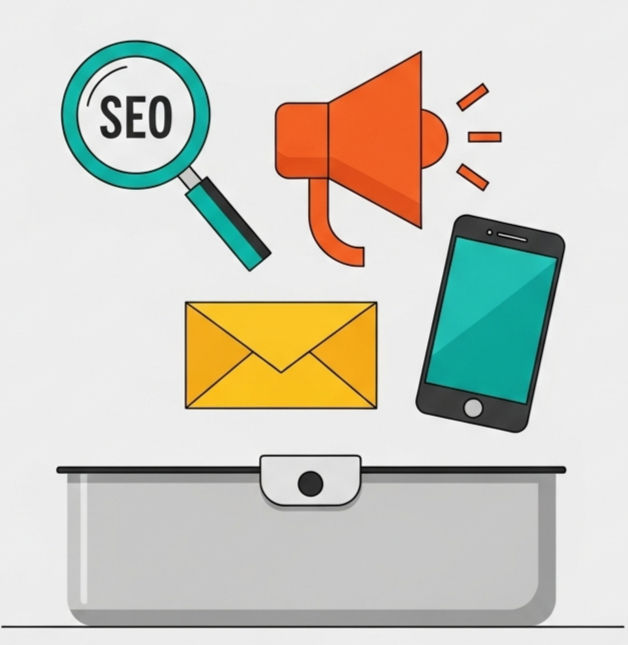
 Image: The four pillars of digital marketing – SEO, Social Media, Mobile (SMS), and Email – highlight the main channels in a strong online strategyslicktext.comslicktext.com.

  • Search Engine Optimization (SEO): SEO means optimizing your website and content so it ranks highly on search engines. Why is this vital? Because 75% of users never click past the first page. If someone Googles “best pizza [YourCity]” or “how to knit a scarf,” good SEO makes your site appear at the top. More visibility means more traffic and potential customers every day.

  • Content Marketing: Great content builds trust. This includes blog posts, videos, infographics, e-books anything that provides value or entertainment. The goal is to attract your audience with helpful information, not just hard-sell. Investopedia explains that content marketing “reaches potential customers through the use of written, visual, or video content that interests them,” which is then promoted via social, email, or SEO. For example, a gardening store might publish a video on how to plant spring flowers, attracting hobbyist gardeners and establishing the shop as an expert. Over time, this builds trust and keeps your brand top-of-mind.

  • Social Media Marketing: Platforms like Facebook, Instagram, Twitter, LinkedIn, TikTok, etc. are essential for connecting with customers. In fact, over 2.3 billion people use social media. Use these channels to build community: share photos, stories, and updates. It’s a place to showcase your brand’s personality. Organic posts build goodwill, and you can also run paid ads to target specific audiences (demographics, interests, etc.). Bonus: about 70% of users expect customer support via social, so it’s a direct line to your audience.

  • Email Marketing: Don’t underestimate email it’s still a superstar. An email list gives you direct access to interested readers. You can send newsletters, promotions, or tips right into their inbox. As noted above, email often yields 500 for every 1. Even a simple monthly newsletter with a special offer can drive repeat business. (Tip: personalize your emails and include a clear call-to-action.)

  • Paid Advertising (PPC): Pay-per-click ads put your message in front of searchers or social-media users. Google Ads and Facebook/Instagram Ads let you target keywords, demographics, interests, and more. You only pay when someone clicks. According to Investopedia, PPC campaigns can segment audiences very precisely. It’s like renting prime billboard space on the internet, immediate visibility to people actively searching or scrolling.

  • Affiliate & Influencer Marketing: These tap into others’ audiences. In affiliate marketing, bloggers or affiliates promote your products and earn a commission on each sale. Influencers (YouTubers, Instagram stars, etc.) work similarly by reviewing or featuring your product to their followers. Big companies (like Amazon) pay out millions to affiliates each year, showing how powerful this can be. Essentially, it’s trusted word-of-mouth on a large scale.

  • SMS/Mobile Marketing: Text messages get opened, nearly 98% of the time. If customers opt in, you can send short updates or flash deals straight to their phones. A timely “Sale starts tomorrow!” text can trigger an instant response. (Just be sure not to spam!)

  • Analytics & Optimization: Finally, track everything and improve continually. Use tools like Google Analytics, social-platform insights, and email dashboards to monitor performance. Key metrics include website traffic, engagement (likes, shares, comments), conversion rate, and ROI. By measuring these, you see what’s working. If an ad or post underperforms, tweak it. Data-driven adjustments (A/B tests, etc.) keep your strategy sharp and growing.


Building Your Digital Strategy

Even a “dummy’s guide” needs a plan. Here’s a step-by-step approach:

  1. Know Your Audience: Who are you trying to reach? Define your ideal customer (age, interests, pain points). For example, if you sell eco-friendly sneakers, your audience might be environmentally conscious young adults. Tailor your message to what they care about.

  2. Set Clear Goals: What do you want to achieve? More website traffic? Leads? Sales? Make goals specific and measurable (e.g. “increase online sales by 20% in 6 months”). This will guide which tactics you choose.

  3. Choose the Right Channels: Use the channels your audience uses. If you target professionals, LinkedIn and industry blogs might be best. If you target teens, consider TikTok or Instagram. It’s better to excel on a couple of platforms than to spread yourself thin.

  4. Plan Your Content: Decide what content or ads you’ll create. This might be blog articles, videos, social posts, or email sequences. Create a content calendar of topics and deadlines. Ensure each piece aligns with your brand voice and goals.

  5. Allocate Budget & Resources: Determine your budget and tools. Will you spend on ads, design, or video production? Even a small budget can be powerful. Allocate funds for advertising and any platforms or freelancers you need.

  6. Implement & Test: Launch campaigns on a small scale first. Use A/B testing (compare two versions of an email subject line, ad image, etc.) to learn what works best. Digital marketing allows quick experiments, so keep testing new ideas.

  7. Measure KPIs: Track performance using analytics. Monitor website traffic, social engagement, lead signups, and sales. For example, SlickText recommends key metrics like traffic, engagement, conversion rate, and ROI. If something isn’t working (e.g. a low click-through rate), adjust it or try a new approach.

  8. Iterate: Data is your friend. Successful marketers make decisions based on analytics, not guesswork. Keep refining your strategy: tweak content, pause what’s underperforming, and test new ideas. Over time, your campaigns will become more effective.

Here’s a simple checklist to summarize:

  • Identify your target audience and their needs.

  • Pick the best channels for that audience (social, email, search, etc.).

  • Create high-quality, relevant content for each channel.

  • Allocate your budget wisely (ads vs. content vs. tools).

  • Track performance and adjust on the fly.


A Digital Marketing Scenario

Let’s make this concrete. Meet Lila’s Cupcake Shop, a small bakery hoping to sweeten its sales. Lila uses a blend of digital tactics:


ree
  • SEO & Local Search: Lila optimizes her website for searches like “cupcakes [HerCity]” and “best cupcakes nearby,” and she claims her Google Business listing. Now when locals Google “best cupcakes,” Lila’s shop appears near the top (remember, 75% of searchers never leave page 1).

  • Social Media: She posts mouth-watering photos of her cupcakes on Instagram and Facebook. With billions on social media, her photos reach more eyes. Lila engages by replying to comments and using popular hashtags (like #CupcakeLove).

  • Email Newsletter: At checkout, customers give their email. Each week, Lila sends a newsletter with a new flavor and a coupon. Because email ROI is huge, even one well-written email (like a monthly special offer) can boost sales. It keeps her shop on everyone’s mind.

  • Facebook Ads: Lila runs a small Facebook ad targeting people in her city who love baked goods. This brings new followers to her page and foot traffic to the store.

  • SMS Alerts: For holidays (Valentine’s, Halloween), Lila sends a quick text blast (“Valentine’s Cupcake Sale starts tomorrow!”). Texts get seen right away (~98% open rate), so even a brief message drives instant action.

  • Measure & Adapt: Lila monitors Google Analytics and Facebook Insights. She sees which posts and ads bring visitors to her website. If an Instagram post is popular on weekends, she posts more then. If an ad flops, she stops it. This data-driven approach keeps improving her strategy.

  • Result: Over a few months, more locals know about Lila’s Cupcakes. Her weekly sales steadily increase. All because Lila mixed smart planning (target audience + content) with ongoing optimization.

This scenario shows the playbook in action. Define goals, choose channels, create engaging content, measure results, and iterate. Every business will have its own flavor of digital marketing, but the recipe is similar.


Key Takeaways and Best Practices

  • Be Audience-Centric: Always start with your customer. What problems or interests do they have? What entertains them? Tailor your content and ads to those needs.

  • Quality Over Quantity: You don’t have to be on every platform. It’s better to do a few things exceptionally well than to spread yourself thin.

  • Consistent Branding: Use a consistent voice and visuals across channels. Every tweet, blog, or email should “sound” like you. Even using the same colors or fonts helps people recognize your brand.

  • Storytelling Wins: Humans love stories. Weave narratives into your marketing (company history, customer success stories, behind-the-scenes). A compelling story makes your brand memorable.

  • Test and Learn: Run A/B tests on subject lines, images, and calls-to-action. Small experiments teach you what your audience responds to. Data-driven tweaks make a big difference.

  • Stay Curious: Digital marketing evolves fast. Follow industry blogs, try new formats (like short-form video or live streams), or experiment with trending tools (even AI-powered ad creators!). Staying informed keeps your strategy fresh.


Remember, digital marketing is not a one-time trick but an ongoing journey. As long as you keep measuring, learning, and adapting, your online presence will only get stronger.

Now go forth, launch that campaign, and let the data (and your inner marketing geek) guide you to online success—dummy-proof style!


Stay tuned for the next blog which delves deeper into how to track performance on digital marketing!


I work in the Personal Care division of ITC, a company whose story begins in tobacco and stretches across a hundred years of Indian consumer evolution. I spend my days immersed in scents and textures, tweaking the formulation of a body wash, debating the shape of a soap bar, or watching customers pick up our products on a shelf, smell them, and sometimes, put them right back. That moment, that subtle pause, always gets me. What was missing? The formulation was right. The claim was strong. But something invisible didn’t click.

It’s this curiosity that led me down the rabbit hole of neuromarketing, a science that peers directly into the subconscious circuitry of consumer behavior. Martin Lindstrom’s Buyology is not a marketing textbook; it’s a thriller. And as I read it, I kept visualizing moments from my job—product trials, brainstorming sessions, even packs being rejected on gut feel. Everything started to make sense.


When Warnings Trigger Cravings

ree

It was a cold, sterile room. The hum of an fMRI machine was the only sound, a stark contrast to the storm of activity it was about to reveal inside a smoker's brain. This wasn’t just a medical scan, it was a quest to uncover how our brain truly makes decisions, revealing how little control we actually have over what we believe to be conscious choices. Through neuromarketing studies using fMRI and SST (Steady State Topography), Lindstrom takes us into the murky waters of human desire, addiction, and belief. And what emerges is a powerful truth: most of our decisions aren’t made in the rational parts of our brain at all.

You’d think graphic cigarette warnings would make people want to quit. But in a shocking twist, Lindstrom found that for smokers, viewing these warnings activated the nucleus accumbens, the very part of the brain associated with cravings and addiction. These warnings weren’t terrifying. They were tempting. This discovery raised difficult ethical questions. Could fear-based marketing backfire? Could anti-smoking campaigns actually make smokers want to smoke more?


Why Coke Wins, Even When Pepsi Tastes Better

Remember the Pepsi Challenge? People consistently chose Pepsi in blind taste tests. But when they knew what they were drinking, the game changed. Dr. Read Montague discovered that while Pepsi triggered the brain’s reward center (the ventral putamen), Coke activated the medial prefrontal cortex—the area linked to memory, emotions, and self-identity.

ree

Meaning, when you drink Coke, you’re not just tasting cola. You’re drinking decades of ads, childhood memories, holiday jingles, and shared moments. Your brain isn’t picking a flavor. It’s choosing a story. Yes, that's what good branding can do to a product!


Why Religion and Branding Use the Same Playbook

ree

Rituals, symbols, storytelling, repetition, and faith: these aren’t just tools of religion. They’re the foundation of some of the most successful brands in the world.

Lindstrom points out eerie parallels:

  • Apple stores look like minimalist churches.

  • Communion-like rituals appear when we unbox a new iPhone.

  • Brand icons (like Nike's swoosh or the McDonald's arches) mirror religious symbols that carry deep emotional meaning.

Brands use rituals and repetition to build belief systems. We don't just "like" a brand—we belong to it.


Mirror Neurons and the "I Want What She's Having" Effect

Ever notice how you crave a Coke just by watching someone else take a sip? That’s your mirror neurons at work. These brain cells fire both when you perform an action and when you observe someone else performing it. In one experiment, participants watching a man drink a Gatorade activated the same brain regions as if they themselves were drinking it.

Implication: Marketing that mimics real-life experiences—someone eating, applying lotion, unboxing a product—can bypass logic and make us feel like we're already participating in the act.


Why Cars Have Faces and Scents Are Strategy

ree

Why do some cars make us feel safe, others sexy, and some just... lovable? Because our brains are wired to see faces—even in machines. Daimler Chrysler discovered that the Mini Cooper’s “face” activated the same brain regions we use to recognize human faces. Its childlike expression triggered emotional bonding. Meanwhile, new car smell? It’s not the scent of plastic, it’s a synthetic fragrance designed to trigger desire and the feeling of success. Brands engineer scents (from the smell of Abercrombie stores to Crayola crayons) because scent is directly linked to memory and emotion, more so than any other sense.


The Political Power of Fear

In politics, emotion wins over logic every time. Lindstrom explored how emotional political ads like the infamous Daisy ad or 9/11 imagery activate the amygdala, our brain’s fear center. This activation leads to lasting subconscious biases, often stronger than policy-based messaging. What you believe about a candidate might not come from what they say, but how their image feels; trustworthy, familiar, strong.


ree

Rituals, Consistency & Belief

One of the most profound themes Lindstrom explores is the power of rituals. Whether it’s brushing your teeth, tying your shoelaces, or unlocking your phone, rituals give us comfort, structure, and belief.


Great brands leverage this:

  • Starbucks’ specific cup sizes and order language.

  • Oreo’s twist-lick-dunk.

  • The unboxing of an Apple product.

The more ritualistic a product’s use becomes, the more emotionally sticky it is. We’re not just using it, we’re embedding it into our identity.


What This Means for Us as Consumers

Neuromarketing isn't just a tool for better ads. It’s a mirror showing us the hidden architecture of our minds.

It reveals:

  • We don't always buy the better product. We buy the better story.

  • We aren't scared off by fear. Sometimes, we're drawn to it.

  • We don't decide with logic. We decide with emotion, and then rationalize it afterward.


But this awareness is also a superpower. If we can learn to pause, to examine the stories brands are selling us, we regain control.


The Invisible Ink of Desire

ree

Reading Buyology is like putting on x-ray glasses. You begin to see through the packaging, the jingles, the political slogans, and even your own preferences. You realize: The story of your brain is the story of marketing. And while much of it is written in invisible ink, the pen is in your hand. So the next time you're drawn to a soda, a politician, or a shiny new phone, ask yourself: Is this truly my choice?


bottom of page